The Small Business Owner's Guide to Choosing Between LLC, S-Corp, and C-Corp Status
By Toring Consulting Services, Inc.
•

Introduction
Selecting the right business structure is one of the most crucial decisions you'll make as a business owner. This choice impacts everything from your tax obligations to your personal liability and ability to raise capital. Let's explore each option in detail to help you make an informed decision.
Limited Liability Company (LLC)
Tax Implications
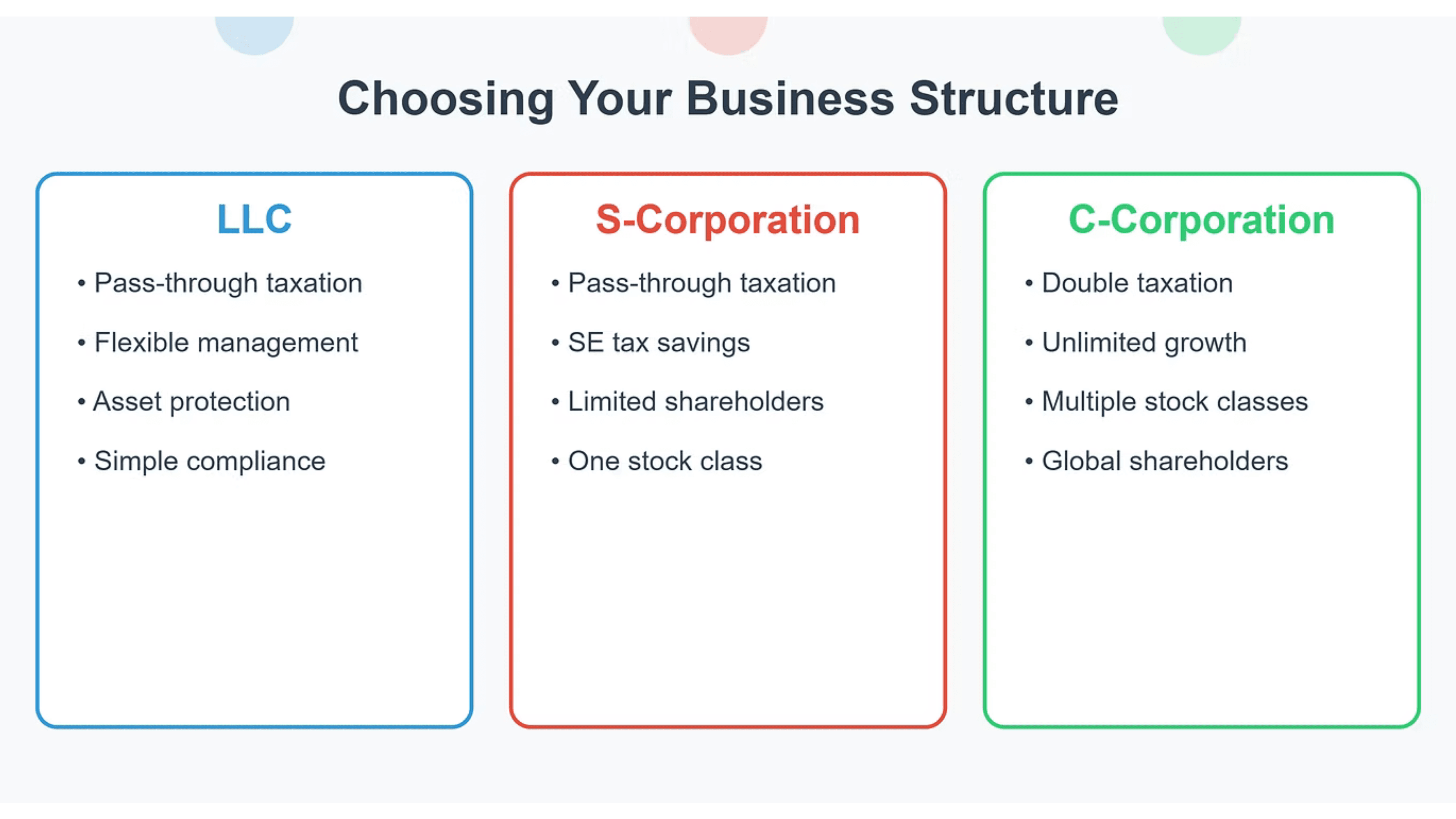
An LLC offers remarkable flexibility in taxation. By default, single-member LLCs are treated as sole proprietorships, and multi-member LLCs are treated as partnerships for tax purposes. However, LLCs can elect to be taxed as either an S-corporation or C-corporation.
Key Benefits
Pass-through taxation (profits and losses pass directly to personal tax returns)
Flexible profit distribution among members
Less rigid compliance requirements
Protection of personal assets from business liabilities
No restrictions on ownership
Potential Drawbacks
Self-employment taxes on all profits
May have limited life in some states
More difficult to raise capital through stock sales
Variable state filing requirements
S-Corporation
Tax Implications
S-corporations are pass-through entities, meaning profits and losses flow through to shareholders’ personal tax returns. A key tax advantage is the ability to split income between salary and distributions, potentially reducing self-employment taxes.
Key Benefits
Avoid double taxation
Potential savings on self-employment taxes
Personal asset protection
Easier transfer of ownership through stock sales
Established legal structure with extensive case law
Potential Drawbacks
Strict eligibility requirements:
Limited to 100 shareholders
Shareholders must be U.S. citizens/residents
Only one class of stock allowed
More complex compliance requirements
Must pay reasonable compensation to owner-employees
C-Corporation
Tax Implications
C-corporations face double taxation: the corporation pays taxes on profits, and shareholders pay taxes on dividends. However, they offer the most tax-deductible business expenses and can retain earnings for growth.
Key Benefits
Unlimited growth potential through stock sales
Strongest liability protection
Ability to offer multiple classes of stock
No restrictions on ownership
Full deduction of employee benefits
Can retain earnings at corporate tax rates
Potential Drawbacks
Double taxation on distributed profits
Higher formation and maintenance costs
Complex regulatory requirements
More expensive accounting and legal needs
Making Your Decision: Key Considerations
Consider an LLC if:
You want flexibility in taxation and management
You’re a small to medium-sized business
You want simpler compliance requirements
You don’t plan to seek external investors
Consider an S-Corp if:
You want to save on self-employment taxes
You meet the ownership restrictions
You want the benefits of incorporation with pass-through taxation
You plan to sell the business in the future
Consider a C-Corp if:
You plan to seek venture capital or go public
You want to offer multiple classes of stock
You need to retain significant earnings in the business
You plan to have international shareholders
Tax Planning Strategies
LLC Tax Strategies
Consider electing S-corp taxation to save on self-employment taxes
Maximize pass-through deductions under Section 199A
Structure operating agreements to optimize tax distribution
S-Corporation Tax Strategies
Balance salary vs. distributions to minimize payroll taxes
Time distributions carefully for tax efficiency
Utilize shareholder basis planning
C-Corporation Tax Strategies
Maximize deductible business expenses
Consider qualified small business stock treatment
Plan dividend distributions strategically
Final Considerations When Choosing Between LLC, S-Corp, and C-Corp Status
The optimal business structure depends on various factors:
Current and projected revenue
Number of owners/investors
Growth plans
Exit strategy
State of operation
Industry regulations
It's crucial to consult with qualified tax and legal professionals before making your final decision. They can help you understand the specific implications for your situation and ensure compliance with all requirements.
Remember that your business structure isn't permanent – you can change it as your business evolves, though there may be tax implications for doing so.
Next Steps
1. Assess your business goals and financial projections
2. Consult with tax and legal professionals
3. Compare formation and ongoing compliance costs
4. Review state-specific requirements
5. Consider future business plans and exit strategies
Making an informed decision about your business structure now can save significant time and money in the future while providing the framework for sustainable growth and success.
Disclaimer
This guide provides general information and should not be construed as tax or legal advice. Please consult with qualified professionals for advice specific to your situation.