
High-Income Roth IRA Strategies: 2026 Backdoor Roth Guide
By Toring Consulting Services, Inc.
•
Introduction
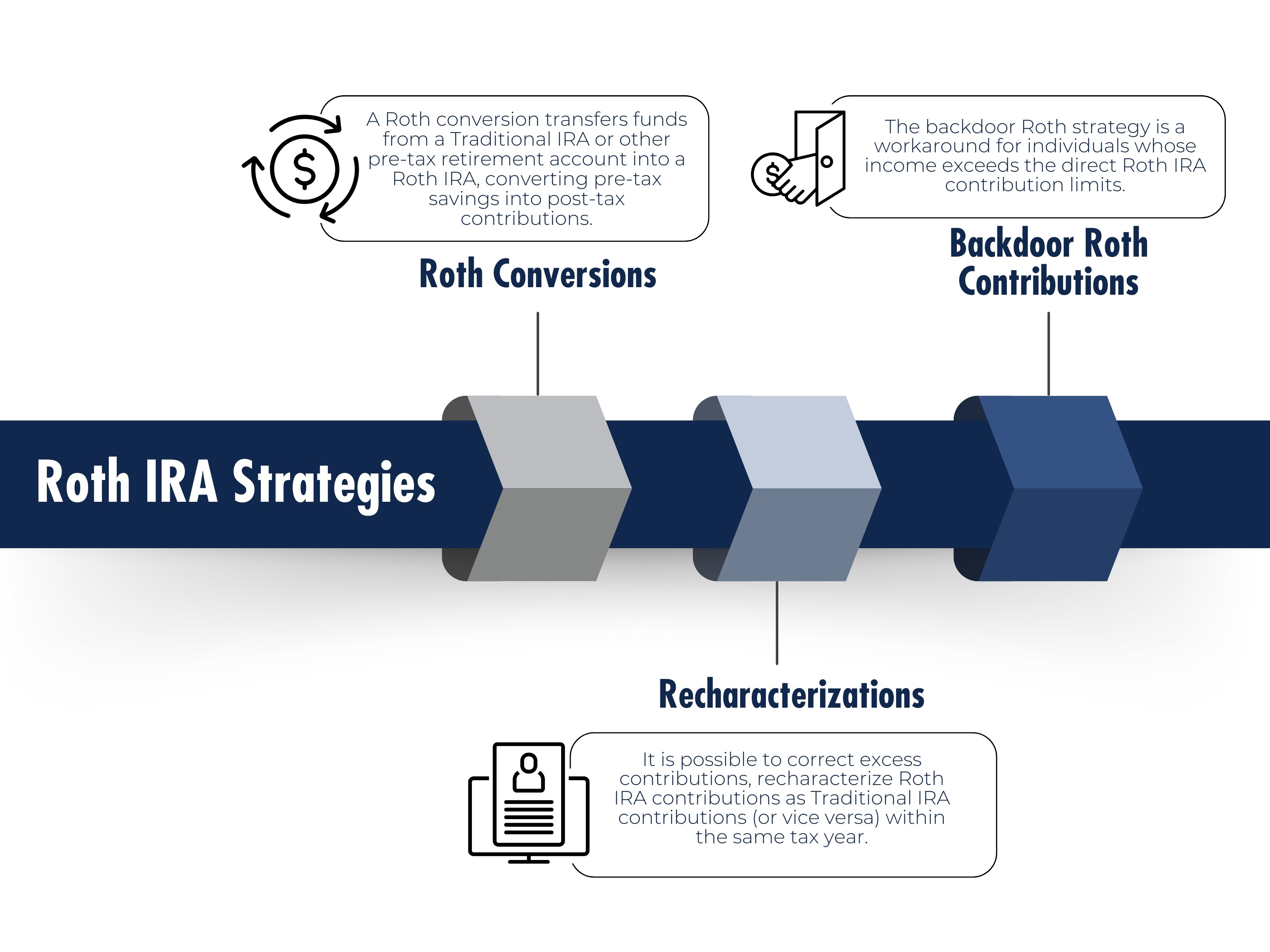
Navigating Roth IRA strategies can be complex, but understanding the differences between conversions, recharacterizations, and backdoor Roth contributions is crucial for optimal retirement planning. Let's break down each strategy and its tax implications.
Annual Limits and Income Restrictions (2026)
2026 IRA limit: $7,500, plus a $1,100 catch-up for age 50 or older, for a total of $8,600. For married couples filing jointly, the Roth IRA direct-contribution phaseout is $242,000 to $252,000 of modified AGI. Check filing status and current IRS guidance.
Roth Conversion
What Is It?
A Roth conversion involves moving money from a traditional IRA or retirement account into a Roth IRA. This process converts pre-tax retirement savings into after-tax Roth IRA funds.
Tax Implications
The converted amount is added to your taxable income for the year
You’ll pay ordinary income tax on the converted amount in the year of conversion
No early withdrawal penalty applies to the conversion itself
Future qualified distributions from the Roth IRA will be tax-free
Strategic Consideration
Best implemented in years with lower incomes
Can be done partially to manage tax brackets
Consider state tax implications
May benefit those who expect higher tax rates in retirement
Five-year holding period applies for qualified distributions of converted amounts
Recharacterization
What Is It?
Prior to 2018, recharacterization allowed you to undo a Roth conversion by returning the converted amount to a traditional IRA. However, the Tax Cuts and Jobs Act eliminated the ability to recharacterize Roth conversions.
Current Status
Roth conversion recharacterizations are no longer permitted
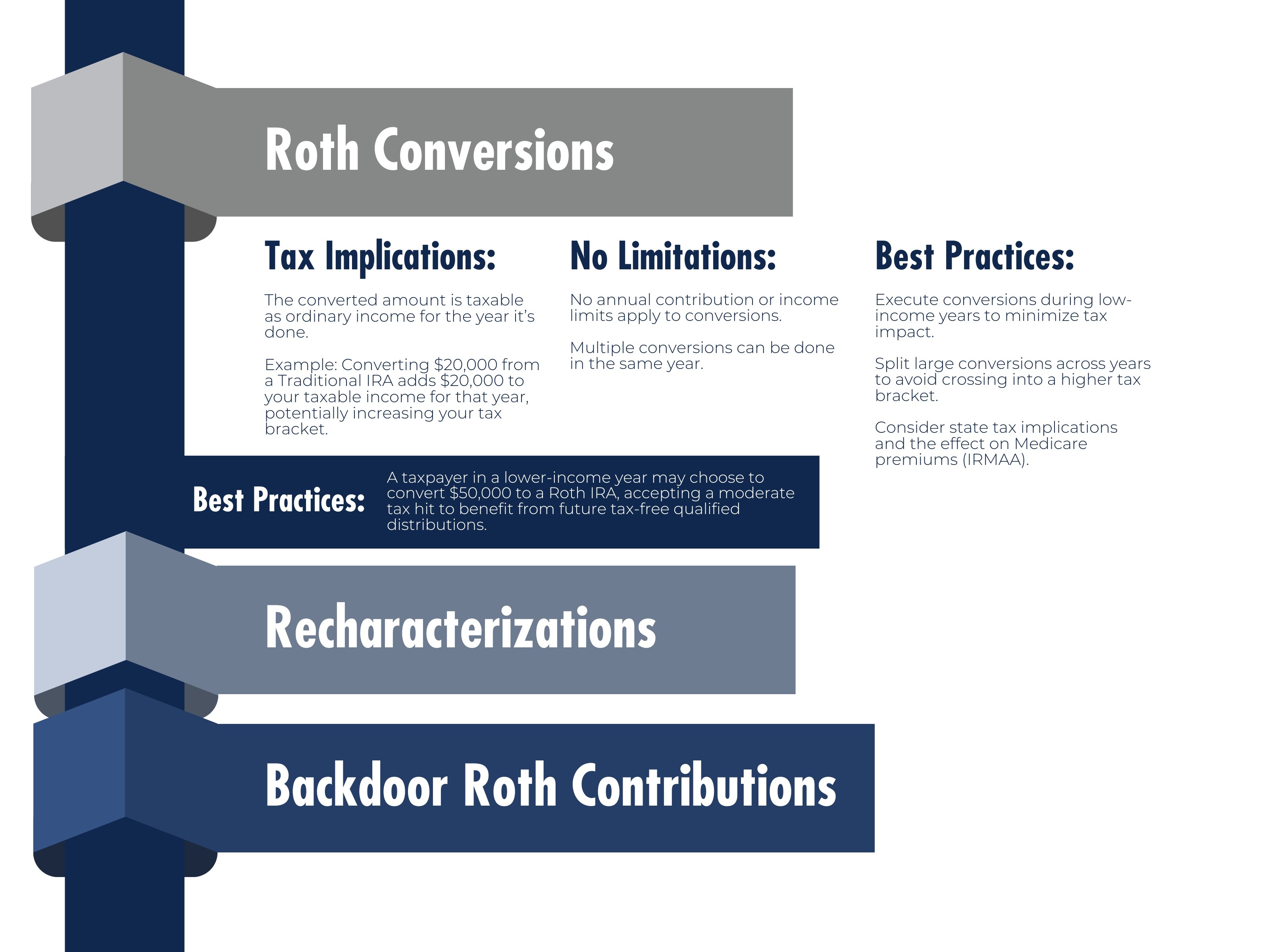
You can still recharacterize Roth IRA contributions to traditional IRA contributions (and vice versa) within the same tax year
Must be completed by your tax filing deadline (including extensions)
Tax Implications
Recharacterizing a contribution removes the tax impact of the original contribution
Helps correct excess contributions or optimize tax situation
Any earnings or losses follow the contribution being recharacterized
Backdoor Roth IRA
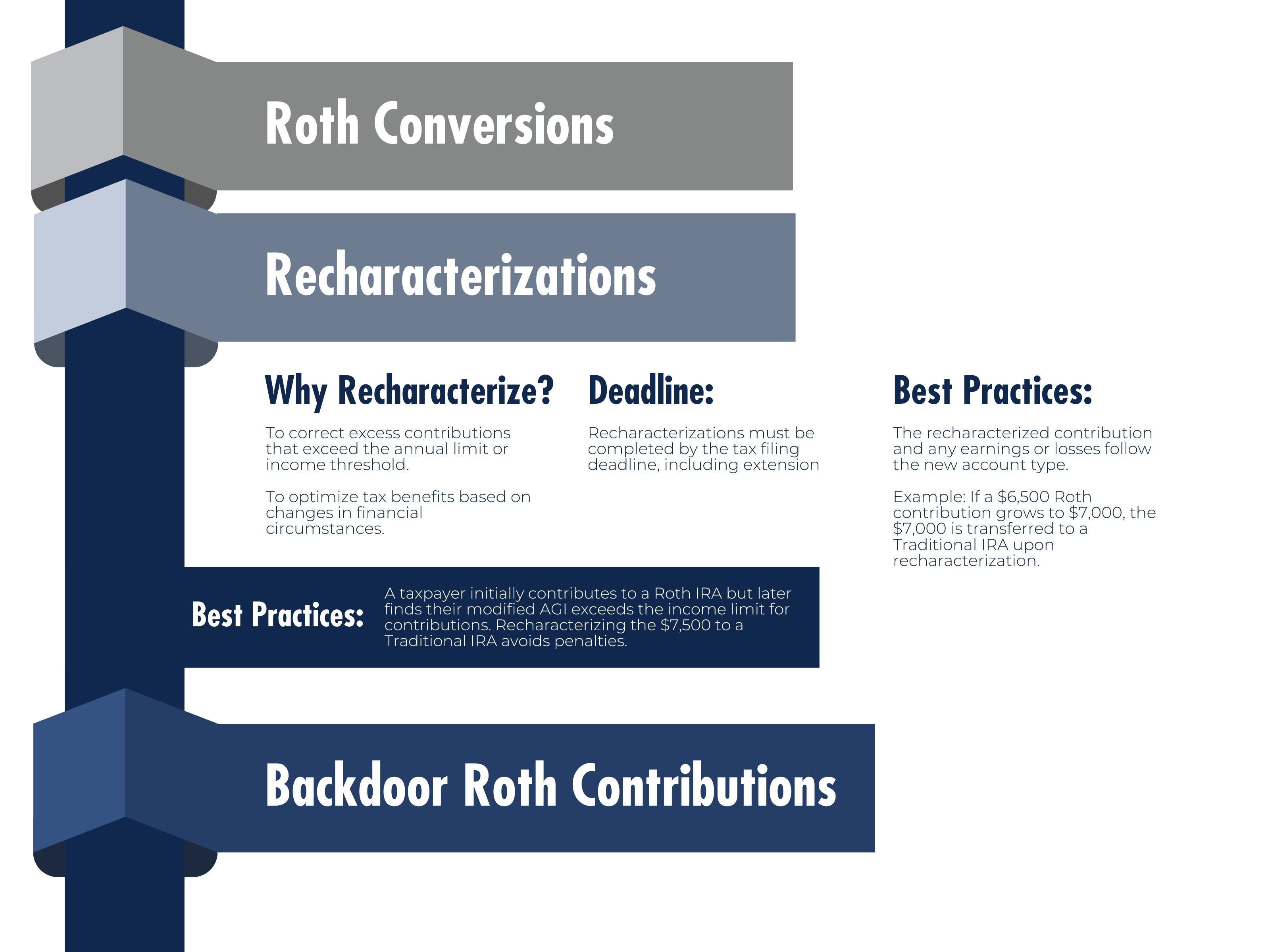
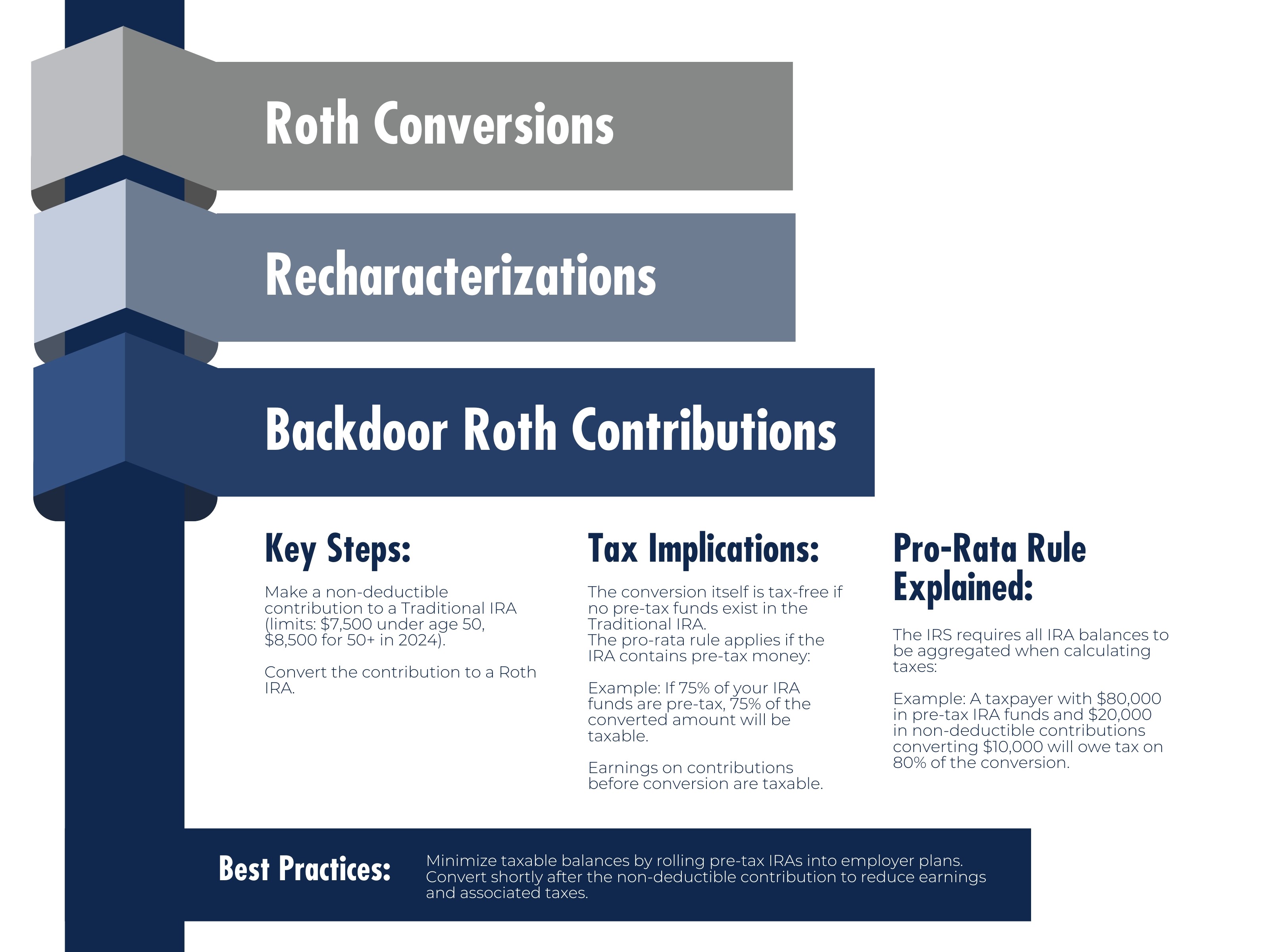
Backdoor Roth mechanics: a nondeductible traditional IRA contribution followed by a Roth conversion can be taxable under the pro-rata rule. All traditional, SEP and SIMPLE IRA balances are considered on December 31. Form 8606 is generally required.
Strategic Planning Considerations
Timing
Conversions are reported in the year completed
Consider spreading large conversions across multiple tax years
Plan around other income events
Consider impact on Medicare premiums (IRMAA)
Documentation Requirements
Keep records of all IRA contributions and their tax status
Maintain documentation of conversions
Track basis in traditional IRAs
File Form 8606 annually when required
Risk Factors
Market volatility during conversion
Impact on other tax benefits and credits
State tax treatment may differ
Five-year holding periods for different types of Roth money
Best Practices
Before Converting
Analyze current and future tax brackets
Calculate pro-rata rule impact
Consider state tax implications
Review impact on other tax benefits
Ensure funds available to pay conversion tax
For Backdoor Roth
Minimize other IRA balances if possible
Convert quickly after contribution
Document all steps carefully
Consider rolling existing IRAs into employer plans
File Form 8606 accurately
Common Mistakes to Avoid
Avoid oversimplification: do not treat the step-transaction doctrine as a categorical ban on ordinary backdoor Roth execution. Timing, documentation, IRA balances and individual tax facts should be reviewed. A rollover option may be available in some circumstances.
Conclusion
Each Roth IRA strategy serves different purposes and comes with unique tax implications. The optimal approach depends on your individual circumstances, including:
Current and future tax brackets
Overall retirement strategy
Available funds for tax payment
Other retirement account balances
Time horizon to retirement
Consider consulting with a qualified tax professional or financial advisor to determine the best strategy for your situation.
Note
Contribution limits and income thresholds typically increase annually based on inflation adjustments. Always verify current limits with the IRS or a tax professional, as these numbers are subject to change.
Disclaimer
This information is for educational purposes only and should not be considered tax or financial advice. Please consult with qualified professionals for advice specific to your situation.